TOFI

Thin Outside, Fat Inside. What does that mean?

This is something that I have to confess was quite shocking to me when I first heard about it. It relates to people that appear to be slim on the outside but still have an excess amount of visceral fat – or internal fat as opposed to subcutaneous fat, which is found just beneath the skin. Visceral fat lies around vital organs, the muscle and heart. Accumulation of visceral fat leads eventually to insulin resistance, diabetes and heart conditions;

Recently, I attended a talk given by Professor Jimmy Bell and organised by the KCL Pharmacology Society, which really changed my perspective on appearance. Professor Bell discussed many aspects of his research, which aims to the development and maintenance of Optimal Health throughout adult life.

Using Magnetic Resonance Imaging (MRI) he was able to show that people of similar age, gender, BMI and same Percent Body Fat had completely different body fat distribution.
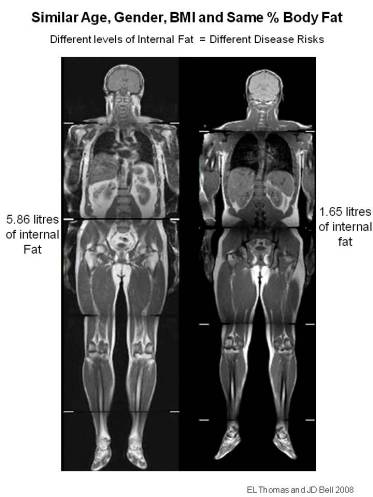
Coronal_Image_of_a_TOFI_and_a_Normal_Control MRI comparing two males of similar age, BMI and same Percent Body Fat. Fat shown as bright and lean tissue as dark.

He stressed that this referred to men and women that have a BMI of 25 or lower and do moderate or no exercise. To my surprise one of the TOFI examples he used, were also underweight people, such as fashion models; Whereas on the other hand, he used the example of Sumo wrestlers that have a BMI of 56 and consume up to 8,000 calories per day but exercise daily and have little visceral fat;

So is BMI adequate to determine if someone is healthy?

Body Mass Index:

Underweight Less than 18.5 kg/m2
Normal Weight 18.5 to 25 kg/m2
Overweight 25 to 30 kg/m2
Obese 30kg/m2 and above
Morbidly Obese 40kg/m2 and above

Although the value for BMI is used commonly to distinguish people that are underweight, normal weight, overweight, obese and morbidly obese, Professor Bell stressed that it is not a definitive measure of health in relation to body fat particularly on the lower range of BMI.

Take Home message: Stay Active!

Whatever the type of exercise, try and complete a workout everyday!

Whether you aim to complete 12,000 steps a day, play a tennis game or just brisk walk 30 minutes a day, add exercise to your routine! Professor Bell’s activity recommendations for those not in favour of the activities mentioned above was to stand up, balance on one foot for a minute then change foot and balance again and make sure this is repeated during the day several times.

Goodbye Fat!

Further Reading if you are interested:

Shojaee – Moradie F., et al. Exercise training reduces fatty acid availability and improves the insulin sensitivity of glucose metabolism. Diabetologia (2007) 50: 404 -413

Thomas E.L., et al. The Missing Risk: MRI and MRS Phenotyping of Abdominal Adiposity and Ectopic Fat. Obesity Journal (2012) 20, 1: 76 – 87

Research Struggles

Like every new beginning, every new job has its benefits and also its struggles. As I have already explained, this summer I had the amazing opportunity to work in the Nursing and Midwifery Department at King’s College London to conduct a systematic review.

If one had asked me back in May how would I go about starting a systematic review, I would have no idea what to answer. Although I had read systematic reviews by the time I started the Research Fellowship, it had never occurred to me what the actual process actually involved. Before starting the Fellowship I decided to keep a diary of everything I did each day, I took note of things that went well and other things that I found more challenging.

Here are my top 5 Research Struggles:

1. Getting familiar with the search engines! 

In the end they do become your best friend, but I had to spend about two weeks familiarising with the different engines Medline/ PubMed, Embase, PsycINFO, Web of Science and getting a feel of what each had to offer. Initially, the tricky part was identifying how each engine was worked – where to set limited criteria and also how to export the papers. My Medline search brought up a very large number of papers of which only a few were relevant in the end. Embase is a pharmaceutical engine and therefore had limited papers relevant to the topic I was looking for; similarly, PsycINFO had only very few relevant sources. Web of Science brought up some useful papers, it was particularly easy to use and particularly helpful as it projected on the side of the search the times the paper had been cited, something I learnt to appreciate over time.

2. Setting inclusion and exclusion criteria

Setting Inclusion and Exclusion criteria was mainly associated with the building of the Protocol for the study. A protocol is a document that describes the reason for conducting the systematic review, the rationale, sets objectives and outlines the organisation of the research project. When setting inclusion/exclusion criteria the struggle was thinking about all the possible parameters that had to be taken into account and making sure everything was included. This is challenging at times, particularly when one is not very familiar with the relevant topic.

3. AND or OR

Finding the correct keywords to use for my search.

Although in some studies this can be fairly simple in the study I conducted it was quite challenging as both cancer and diabetes are two very broad terms. I used many different combinations of keywords until we were happy with both the quantity and the relevance of the papers the search was bringing up. I am not going to lie, it did get frustrating at times spending days doing a search and then realising I had to start all over again. However, I realised that this is the only way to do it.

What I found particularly helpful was creating a visual of the combination of terms I would ideally like to find in a paper. I literally took a paper and drew two circles: one had cancer and all the terms associated (eg. Malignancy, melanoma etc.) and the other had diabetes and all the terms associated (diabetes mellitus, insulin etc.) and this is what lead me to the keywords we ended up using!

What I realised is that there isn’t a right or wrong way for doing this: You Search, You Check for Relevance, You Search, You Check for Relevance…

4. A Large – 4 – Digit Number

Being a stressed person from nature I was initially overwhelmed by the quantity of information! Although for some a large 4-digit-number of results might not seem like a lot, it was enough to make me go up and down the stairs of the eight – floor – building every 2 hours to rejuvenate and restore my frame of mind!

While conducting my searches and reviewing the papers I was overwhelmed with the amount of papers and was also at times scared that I would not be able to complete the project. Although reviewing is overwhelming to start off with, it does actually become better as you go along and this is something I learnt through experience and will have in mind when I conduct research again in the future.

5. Management

I am not sure if everyone feels this way but whenever I start a new job or even start a new project I always get that boost of excitement and that kick followed by slight stress – I like to call that productive stress!

However, when I was presented with that Large – 4 – Digit Number I became so preoccupied that this task would not be completed on time that I ended up constantly feeling that I had not made enough progress and disappointed about my performance. I was however very lucky to have my supervisor beside me along the way. She guided me and reassured me I was on the right track by having a mini – review of the goals accomplished each week. This allowed me to develop a mechanism to cope with managing my time and my stress and was able to complete what I had set to do.

80RYZDJ8UE

I have realised that although I have mentioned all the above as ‘Research Struggles’, these where the things I took away and appreciated during this amazing experience. Entering my second year of studies I have already been able to apply the knowledge that I attained during the summer in a variety of modules and this has made me very happy!

I am very interested to hear what were your ‘Struggles’ when you first had to conduct a review? I am sure there will be similar and different points for each person and I am looking forward to hearing your experience!

KURF

What does KURF stand for?

KURF stands for King’s Undergraduate Research Fellowship.

In late April 2015 I decided to apply for the KURF. Just as I was starting my first exams in May, I found out that I had been accepted for an eight – week fellowship in the Nursing and Midwifery Department at King’s College London to conduct a systematic review on how glycaemic control* is affected during cancer treatment in patients with pre-existing Type 2 Diabetes mellitus. The fellowship required that I become familiar with running a targeted search on a topic forming a protocol for the paper, assessing the literature for relevant papers according to inclusion and exclusion criteria extracting information from selected papers by forming an extraction form assessing bias. At the same time, it involved working with other members of the Cancer Research team in the Nursing and Midwifery Department and primarily with my supervisor, Dr Jo Armes, who provided me with invaluable guidance and support during the fellowship.

*Glycaemic control refers to the regulation of blood glucose levels within a certain range considered as normal (For more information go to NICE guidelines). This can be assessed in Type 2 Diabetes Mellitus patients, by obtaining data of Glycated Haemoglobin (HbA1c) and is a useful measure for its control within a time frame of 1 to 3 months.
How did I apply and why?

I decided to apply for the Fellowship as it offered a great opportunity to become familiar with and engage in academic research in a leading institution, while being mentored by experts in the fields of cancer and diabetes during my undergraduate studies. I have a strong personal interest in the relationship between cancer treatment and diabetes, enhanced after some lectures on diabetes and glycaemic control. As both cancer and diabetes are responsible for an increasing number of deaths today, I considered the correlation between cancer treatment and glycaemic control to be very important for a future dietitian. By participating in this study, I hoped to gain a more comprehensive understanding of this relationship. I was able to learn and apply different research and data analysis methods and to further develop my critical appraisal skills. Finally, I considered this fellowship to be a unique opportunity to contribute to the development of a comprehensive summary of evidence, which would form the basis for a publication that will hopefully have a positive impact on the treatment of patients.

PFDHUN2MLE

My personal experience

My experience of the fellowship has been nothing but positive. Initially, the amount of work that had to be completed in eight weeks seemed daunting; however, as the weeks progressed I felt more confident with the work I was doing and was finally able to complete it. I also had the opportunity to be part of the greater Cancer Research Team and discuss other studies that I was not involved in, gaining a better understanding on the current research taking place, and met with researchers from other teams who shared their experiences with me. In addition to the above, and apart from enriching my knowledge on this topic, I was encouraged to attend talks and events on a number of research topics, an opportunity that further induced my unique academic experience. After attending the talks I would discuss them with the rest of the team and exchange ideas and opinions on the topic. My experience was made so much more inspiring and educating thanks to my supervisor, who was always available to answer my questions and helped me discover and learn more things as the project was developing.

The benefits of the fellowship

This fellowship has been an exciting academic research opportunity for me, through which I gained experience in research and acquired skills that will be very useful for my academic, professional and personal development. During this fellowship I realised that I really enjoy research, but I also believe that such an experience would benefit even people who may not be considering research as a future career. The skills I gained are transcendent and can be applicable in any discipline; these include organising my time for the completion of the project and being able to discuss the topic I am working on and clearly define the scope and aims of my research. Recently, I had my first lecture in Research Methods for Health Sciences a module which is part of my BSc Nutrition and Dietetics, Year 2 and it was then that I realised how valuable this experience has been and will be in the next few years. I felt confident to use the knowledge I had attained during my summer fellowship to problem solve and answer questions.

What does the future hold?

As part of this fellowship I am still working closely with my supervisor, Dr Jo Armes to finalise this project and I am hoping I will be soon able to discuss the systematic review in more detail on ResearchGirlToday. As part of this project, I will have the opportunity to submit an abstract for oral/poster presentation at the Annual King’s Health Partners Nursing Conference in 2016 and this will be a great opportunity to demonstrate the work that has been completed. In the future I am also looking forward to getting involved in other research projects.

Going forward I will use ResearchGirlToday as a platform to relay research information and I would like to consider this website as an ongoing project of the work I started this summer!

DBSSPR0O2Z